
Review · BARCELONA TAPAS TOURS
Gothic Quarter Insights & Tapas Experience
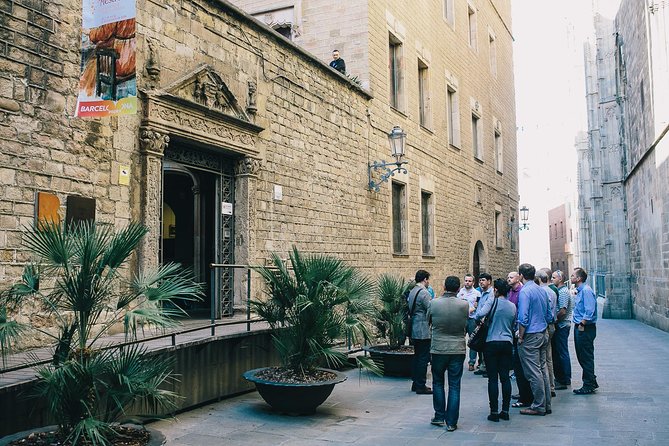
Barcelona’s Gothic Quarter is best understood on foot, one narrow lane and old stone square at a time. This tour links Roman Barcelona, medieval royal power, churches, guild streets, and local food, then finishes with a pintxo and drink. The Roman columns tucked inside a small courtyard are the sort of surprise you could easily miss alone.
I like the clear historical route, which gives you a useful map of the old city instead of a random stroll. I also like the relaxed social finish: after roughly two hours of walking, you sit down with the group for a snack and drink.
The main consideration is pace and scope. At $54.06, this is not a food tour or a full museum visit. You receive one pintxo and one drink, and most of the time goes toward outdoor sights and explanation. One past participant also felt the tour offered more building history than stories and legends, so choose it for context rather than theatrical storytelling.
Key points to know before booking
- Roman roots appear early: Plaça Nova and the Temple of Augustus show that Barcelona’s story began long before the Gothic period.
- The route covers nine major stops: You move from the cathedral area to Santa Maria del Mar and Carrer de Montcada.
- The tour finishes with food: One pintxo and one drink are included, but this is a light snack rather than dinner.
- A guide makes the old quarter readable: Guides such as Ariana, Leah, Maria, and Núria have led past departures, with praise for their warmth and clear explanations.
- Small-group size helps: The maximum is 20 people, though some departures have been much smaller.
- Good first-day timing: The 3:30 pm start works well after arrival or a morning visit to another part of Barcelona.
Plaça Nova and the first glimpse of Barcino
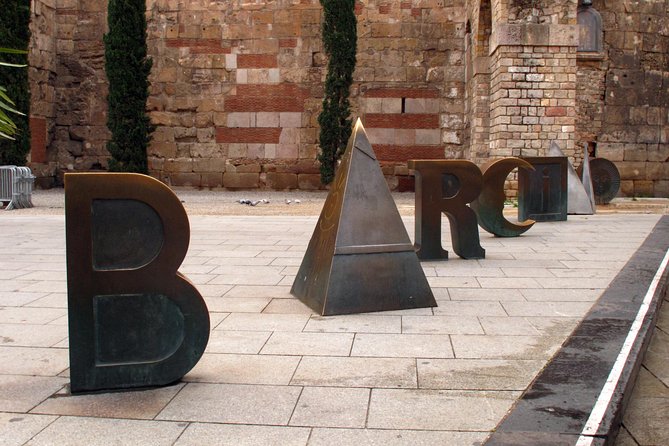
The tour starts at Lamaro Hotel Barcelona on Av. de la Catedral at 3:30 pm. From there, you enter the Gothic Quarter near Plaça Nova, where seven large letters spell Barcino. Six are bronze and one is aluminum, a modern work by Barcelona artist Joan Brossa placed beside the remains of the Roman city wall.
This is a smart opening stop because it gives you two Barcelonas at once. The letters are playful and contemporary, while the wall behind them points back to the Roman settlement that grew into the city you see today.
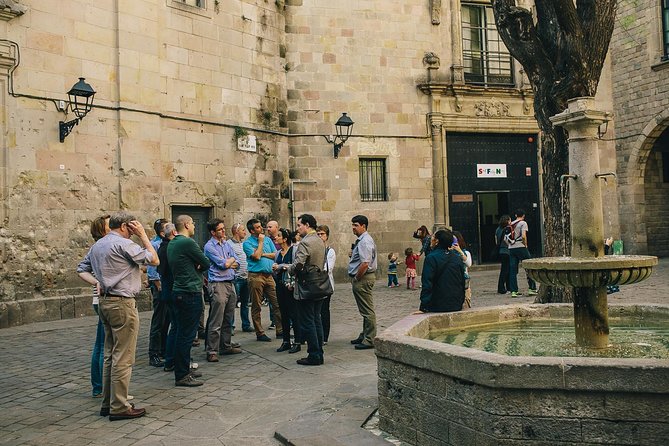
You have about 10 minutes here. That is enough time for photographs and a short explanation, but not for a long artistic discussion. If the meeting area is crowded, look for the guide’s red umbrella. One past departure was complicated by a street fair, and the umbrella helped the group find its guide.
A few more tapas tours around Barcelona worth a look
- Montserrat Half-Day Tour with Tapas and Gourmet Wines
★ 5.0 · 7,359 reviews - Montserrat & Cogwheel Train, Gourmet Wine Tasting & Tapas/Lunch
★ 5.0 · 6,290 reviews - Barcelona Tapas and Wine Experience Small-Group Walking Tour
★ 5.0 · 5,804 reviews
Barcelona Cathedral and the old city gate
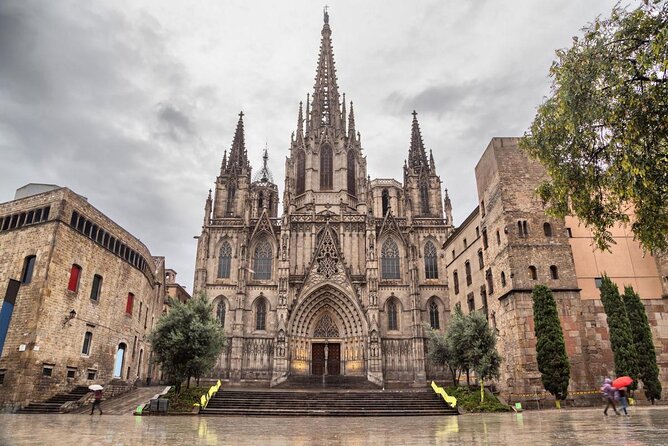
The next stop is Barcelona Cathedral, with about five minutes in the cathedral area. The route also takes in Plaça Nova, a square created in the 14th century after water channels were redirected and buildings near the Roman gate were removed.
The old Portal del Bisbe, or Bishop’s Gate, is the useful detail here. You begin to see how the medieval city reused and reshaped the Roman walls. The building now known as the Bishop’s Palace is tied to the growth of the city’s episcopal center, giving the stop a religious and civic angle.
Do not expect a full cathedral tour or a long interior visit. The value is orientation: your guide helps you read the street plan and understand why the cathedral quarter became the center of medieval Barcelona.
Casa de l’Ardiaca and the layers of one residence
Casa de l’Ardiaca offers a closer look at how old buildings change over time. It served as a residence for the ecclesiastical hierarchy from the 12th century onward, then gained Renaissance additions in the early 16th century.
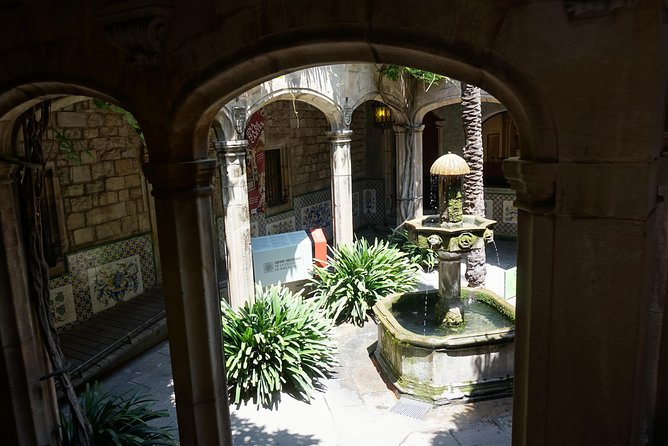
The courtyard and its porticoed design are especially worth noticing. The building combines Renaissance decoration with the more flamboyant Gothic character of the original structure. A staircase leads toward an upper terrace with a balcony that has a distinctly Romeo and Juliet feel.
You spend about 10 minutes here. This is a good stop for anyone who enjoys architecture, because the guide can point out more than age alone. You see how one building can collect new styles, uses, and details without losing its medieval identity.
Plaça Sant Felip Neri, a quiet square with a difficult past
The Gothic Quarter can feel like a maze of narrow lanes, so Plaça Sant Felip Neri comes as a surprise. The small square has a fountain at its center and the Baroque church of Sant Felip Neri facing it. Former guild buildings once housed shoemakers and coppersmiths nearby.
The stop lasts around 10 minutes. It is one of the prettiest pauses on the route, but the square also invites a slower look at the scars and age of the surrounding buildings. Your guide may give the setting more meaning than a quick photograph would.
This is also a place where crowd levels matter. A small square can feel crowded even with a modest group, and you may need to stand close to hear. The maximum group size is 20, which is manageable, but not the same as a private walk.
Same city, a different plate:
- Montserrat with Black Madonna & Medieval Winery with Tapas/Lunch
★ 5.0 · 5,209 reviews - Barcelona: Montserrat and Winery Tour with Tapas or Lunch
★ 4.8 · 4,695 reviews - Barcelona: Tapas Walking Tour with Food, Wine, and History
★ 4.8 · 4,261 reviews - Barcelona: Paella Cooking Experience & Boqueria Market Tour
★ 4.8 · 3,661 reviews
Placeta del Pi and the old cemetery squares
At Placeta del Pi, the Gothic Basilica of Santa Maria del Pi anchors two picturesque squares. The spaces around the church were once cemeteries, and today they provide room for painters and artisans to display their work.
The tour allows about 10 minutes here. I like this stop because it shifts attention away from grand buildings and toward the everyday shape of the old quarter. Small public spaces often tell you how a city used to function, and former burial grounds becoming open squares is a useful example.
You will want comfortable shoes by this point. The walking is not described as strenuous, but the route winds through old streets and includes several hours on your feet. The best approach is to wear shoes you already trust, not brand-new ones brought for the trip.
Plaça del Rei and medieval royal Barcelona
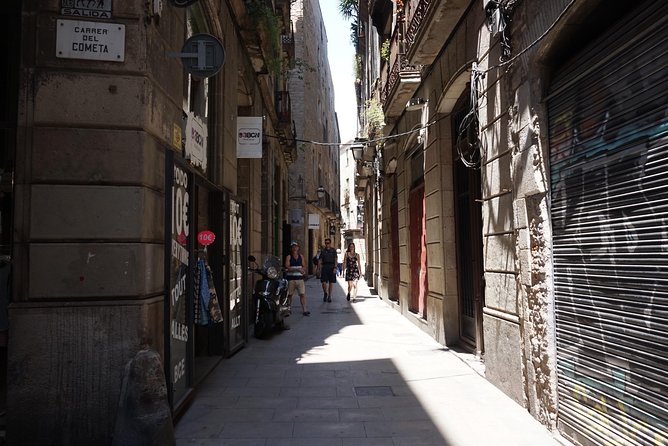
Plaça del Rei is one of the strongest historical points on the route. The square is enclosed by the Palau Reial Major and related buildings, forming one of Barcelona’s clearest medieval architectural groups.
Your guide can help you picture the square as a place of royal power rather than simply another attractive stone courtyard. The peaceful setting makes it easy to miss how important the surrounding buildings once were.
The planned stop is about 10 minutes. You should not expect admission to the royal buildings as part of the tour. All listed stops are free admission points, and the emphasis is on the guide’s explanation and the exterior setting.
For a first visit, this is useful context. It connects the cathedral district, royal authority, and the growth of Barcelona’s medieval center in a single view.
The Temple of Augustus, Barcelona’s best small surprise
The MUHBA Temple d’August is one of the most rewarding stops because the remains are so easy to overlook. Inside a small medieval courtyard on Carrer Paradís, four columns from the Temple of Augustus have survived for more than 2,000 years.
The setting is part of the appeal. You do not approach a wide archaeological park or a grand ruin. Instead, ancient Roman columns appear inside a later building, surrounded by the dense streets of the Gothic Quarter.
The stop lasts about 10 minutes. If you have already seen Plaça Nova and the Roman wall, this visit completes the early Roman thread of the tour. You can connect the name Barcino, the old walls, and the temple remains without needing a separate history lecture.
This is also the kind of place where a guide adds real value. The columns are impressive, but the explanation tells you why they survived and how they fit into the city’s earlier form.
Santa Maria del Mar and the people’s church
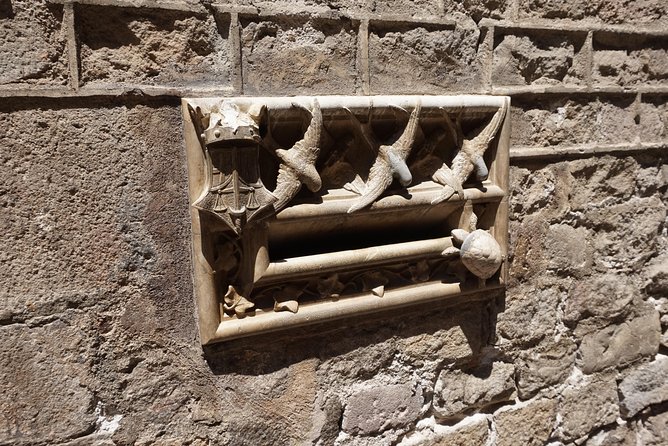
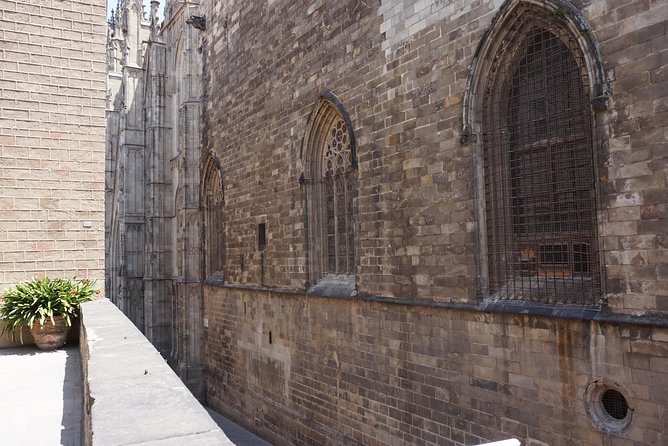
The Basilica de Santa Maria del Mar brings the tour into the medieval neighborhood around the old waterfront. The church is often called the real cathedral of the Old Town because local people helped build it during the Middle Ages.
It is a major example of Catalan Gothic art, and the stop gives the route a different scale after the small lanes and courtyards. The church feels tied to the working community around it, rather than only to kings and bishops.
The listed stop is about 10 minutes. Again, the tour does not include a full interior visit or a separate ticket. You receive an introduction to the basilica and its place in Barcelona’s story, then continue walking.
If you want to explore the church at length, make a separate visit later. The tour’s purpose is to connect it with the wider old-city route, not to replace a dedicated church visit.
Carrer de Montcada and the finish near the old civic quarter
The final listed stop is Carrer de Montcada, the city’s main concentration of medieval civic architecture. The street begins near the Romanesque Marcus Chapel and runs toward Plaça del Born. Its name comes from the important Montcada family, linked to the 12th-century history of Barcelona.
Carrer de Montcada is a fitting final sight because the route ends with grand urban architecture rather than a single monument. You can see how wealthy families, civic life, and trade shaped the medieval city.
The route then returns to the meeting point, where the food portion takes place. The exact bar is not specified, so do not book this expecting a particular restaurant or menu. What is clear is that you receive one pintxo and one drink.
Pintxo, drink, and what the food adds
A pintxo is a small bite, often served with a drink, and it is not the same thing as a full tapas meal. The included snack gives you a taste of Barcelona’s social food culture and creates time to talk with the group after the walking portion.
I see this as a pleasant finish, not the main reason to book. Some past participants particularly enjoyed the beer and pintxo after the tour, while another appreciated learning the difference between a pintxo and tapas. Still, one small bite will not replace lunch or dinner.
The drink may be a useful pause in the afternoon, especially if you have arrived from a cruise ship or spent the morning sightseeing. If you have dietary needs, the supplied details do not specify menu choices, so you should confirm what is available before relying on the snack.
Guide style, languages, and group size
The experience is offered in English, with multilingual guiding listed in English, Spanish, French, and Italian. The included details also identify English, Spanish, and French, so check the language option when booking if your choice matters.
Past departures have included guides named Ariana, Leah, Maria, and Núria, along with a guide named Germans. The strongest pattern is clear explanation paired with a friendly manner. Leah was noted for making the city’s past feel lively, while Núria was praised for stories and legends that worked well for a family with teenagers.
The quality of a walking tour depends heavily on the individual guide. Most of the available feedback points to guides who are warm, prepared, and good at keeping attention. One less enthusiastic assessment found more factual explanation than legends, so you should not expect every departure to have the same storytelling style.
The maximum is 20 people. A small group can make narrow streets easier and questions more practical. Some groups have been as small as four or eight, but you should plan for the full limit rather than assume an intimate private walk.
Is $54.06 a fair price?
At $54.06 per person, the value depends on what you want from the afternoon. You are paying for roughly two and a half hours of guiding through some of Barcelona’s most confusing streets, plus one pintxo and one drink.
The price makes sense if you are visiting Barcelona for the first time and want the Gothic Quarter explained in a sensible order. It can also be useful just after arriving, since the 3:30 pm start gives you a structured introduction without taking a whole day.
The value is weaker if you mainly want food, museum admission, or time inside the cathedral and basilica. None of those is the main focus here. You are buying local orientation, historical context, and a social walk.
The tour is booked an average of 101 days ahead, which suggests you should not leave it until the last minute if your dates are fixed. Free cancellation is available up to 24 hours before the start time. If the minimum number is not reached and the operator cancels, you are offered another date or experience, or a full refund.
Practical advice for the 3:30 pm walk
The meeting point is Lamaro Hotel Barcelona, Av. de la Catedral, 7, in Ciutat Vella. The activity ends back at the meeting point, so you do not need to arrange a separate ride from the final stop.
A mobile ticket is provided, and the meeting point is near public transportation. Service animals are allowed, and most people can take part. You should still allow extra time to find the hotel entrance, especially if the square is crowded or an event is taking place.
Bring water, wear comfortable shoes, and leave room in your schedule after the tour if you want a proper meal. The walk is offered in the afternoon, when the light can make the stone streets and façades especially attractive for photographs.
This outing suits history lovers, first-time visitors, families with older children, and anyone who likes learning the story behind a place before exploring it alone. It is less suited to someone who dislikes walking, wants a private guide, or expects an abundant tapas dinner.
Should you book the Gothic Quarter Insights and Tapas Experience?
I would book this if you want a well-organized introduction to Barcelona’s oldest center, especially early in your stay. The route gives you Roman remains, Gothic churches, royal buildings, medieval civic streets, and a small food stop without taking more than an afternoon.
You should skip it if you already know the Gothic Quarter well or want extended interior visits. You should also keep expectations in check about the food: one pintxo and one drink are a friendly finish, not a meal.
For most first-time visitors, the best use is on the first or second day. You will leave with a clearer mental map, several places worth revisiting, and enough local context to make your later wandering more rewarding.
FAQ
How long does the Gothic Quarter tour last?
The activity lasts approximately 2 hours and 30 minutes.
What time does the tour start?
The tour starts at 3:30 pm.
Where does the tour meet?
You meet at Lamaro Hotel Barcelona, Av. de la Catedral, 7, Ciutat Vella, Barcelona.
Where does the activity end?
The tour ends back at the meeting point.
Is food included?
Yes. The price includes one pintxo and one drink. Additional food and drinks are not included unless specified.
What languages are available?
The experience is offered in English, and multilingual guiding is listed in English, Spanish, French, and Italian. The included tour information specifically identifies English, Spanish, and French, so confirm your preferred language when booking.
Just added around Barcelona
- Barcelona: Guided Rooftop Wine Tasting – Enjoy 6 Spanish Wines★ 4.5 · 61 reviews
- Barcelona Sailing Experience: Spanish Tapas and Premium Open Bar★ 4.5 · 34 reviews
- Vermouth in Catamaran A gastronomic experience in Barcelona★ 5.0 · 5 reviews
- Wine & Cava Penedes Tour: Wineries, Wine Tasting and Tapas★ 5.0 · 5 reviews
- Vermouth Tasting and Crafting in Barcelona★ 5.0 · 4 reviews
- Barcelona: Bike or eBike Tour, Top Sights & Local Insights★ 5.0 · 47 reviews
- Rooftop Paella Seafood Cooking Class Experience in Barcelona★ 5.0 · 59 reviews
- Tarragona Culinary Experience: Olive Oil & Iberian Ham Delight★ 5.0 · 8 reviews
Barcelona Tapas Tours, compared.

Montserrat Half-Day Tour with Tapas and Gourmet Wines
Read our review →
Montserrat & Cogwheel Train, Gourmet Wine Tasting & Tapas/Lunch
Read our review →
Barcelona Tapas and Wine Experience Small-Group Walking Tour
Read our review →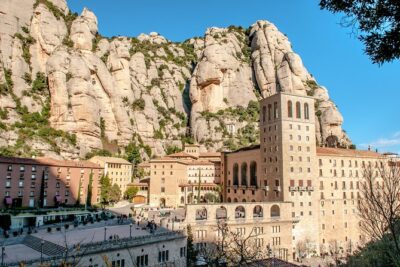
Montserrat with Black Madonna & Medieval Winery with Tapas/Lunch
Read our review →
Montserrat and Winery Tour with Tapas or Lunch
Read our review →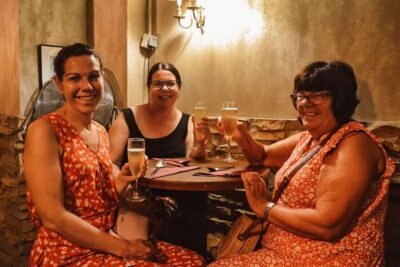
Tapas Walking Tour with Food, Wine, and History
Read our review →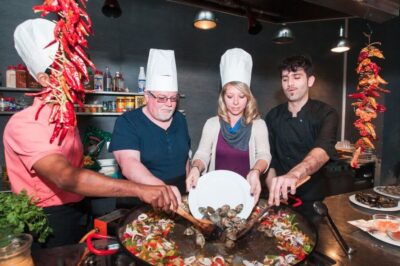
Paella Cooking Experience & Boqueria Market Tour
Read our review →
Barcelona Paella Cooking Class with Market Visit, Tapas & Sangria
Read our review →Browse the lists this tour appears in